
opinion:frater_secessus:lifepo4_charging_voltage
This is an old revision of the document!
Table of Contents
DRAFT
… the reactions that cause [LiFePO4] aging are strongly correlated with voltage - David Howey, Professor of Engineering Science at the University of Oxford1)
Problems caused by lithium charging profiles
You'd think that a “lithium profile” would be suitable for lithium. That may or may not be so for your particular use case. Read on…
excessive charging voltage
So your LiFePO4 battery is acting up:
- won't charge fully
- seems to have reduced capacity
- voltages in the system are spiking, perhaps tripping your inverter
It's fairly common for excessive charging voltage to indirectly cause these symptoms. Unfortunately it's very common for preconfigured Lithium profiles to charge at voltages high enough to start the problematic chain of events.
TLDR
If excessive charging voltage is the problem then reducing the charging voltage will cause the symptoms to improve or disappear. Reducing current can allow passive balancers more of a chance to work.
the full process
- reduce charging voltage (aka “absorption voltage”, “boost voltage”) to something like 13.6v. Float if used, can be set to something like 13.3v-13.4v. You may have to use a USER profile instead of a canned LITHIUM profile to make these changes.2) If you choose to modify the Li profile itself take a pic or notes of the original settings so you know what they were and can return to them later if desired.3)
- observe for a few days. Charging will be slower and may not finish by sundown4); we want to see if it can keep on charging rather than trigger BMS cutoff.
- if symptoms do clear up you can start to raise the charging voltage back up gradually (13.65v, 13.7v, 13.75v, etc) or you can leave it low if you are getting enough charge. {note from secessus: there is little benefit to charging LiFePO4 >13.8v.] Float can remain low at 13.3v-13.4v.
- if it starts acting up again drop charging voltage back down a notch or two
why lower-voltage charging works
LiFePO4 will fully charge at voltages as low as the mid-13s, but it will take more time. That extra time is called “Absorption duration”5). At the kinds of current levels we usually see in offgrid charging6) the duration looks like this:
- ≥14.0v will charge to ~100% SoC with zero minutes of absorption durations: hit the voltage setpoint and stop. Cell voltages tend to diverge as charging voltage increases above 14.0v because they are further up the knee (see below)
- 13.8v will charge to ~100% SoC with a small amount of Absorption (10-30 minutes?) and cells tend to stay in balance.
- 13.6v will charge to ~100% SoC with several hours of Absorption (example with data) ←- where we are starting
why the problem occurs
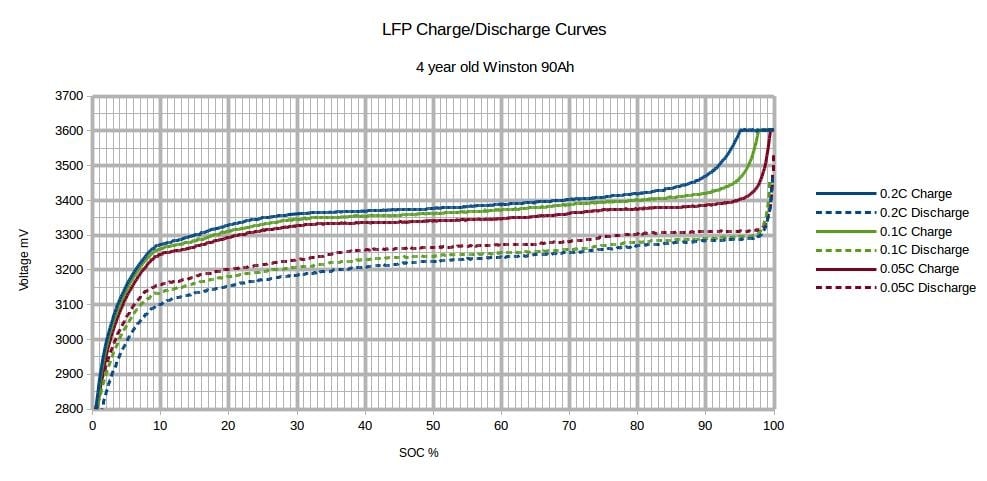
- lithium cell voltages are very “flat” for most of their usable capacity. When deeply discharged the voltage drops off dramatically, and when they are overcharged their voltage spikes dramatically. Because of the shape of this voltage curve we sometimes say there is a “lower knee”, broad flat middle, and “upper knee”.
- when one cell hits the knee first it can “run away” voltage-wise, and do so quite suddenly. This unevenness in cell voltage is called “imbalance” and is more likely to happen with higher charging voltages.7)
- the BMS sees the runaway and stops further charging to avoid damaging the cell8)
- but the charger was charging before the battery apparently “went away” and it takes a non-zero amount of time to back down from charging
- which results in a voltage spike on the rest of the system before the charger[s] can back down
- bank voltage rests and/or is pulled down by loads
- BMS re-enables charging
- depending on the setup this might be a seemingly-endless loop9)
If the cell imbalance is bad enough the battery can't charge anywhere near full because the misbehaving cell is causing charging to shut down early. So we ease up on charging which encourages the cell to stay in line with the others, which allows for a full battery charge.
The bigger question is this: why do battery and charger manufacturers specify such high charging voltages in the first place? It's not a plot; there really are some benefits to charging at higher voltages, especially when selling to the general public.
active balancing
 If the above does not work10) stronger measures may be required.
- passive balancers like the ones that come in most retail LFP batteries burn off11) a (very) small amount of current12) to try to drop the voltage of “runner” cells. Robin Hood steals from the rich and burns their excess money in a campfire.
- active balancers transfer13) energy from runners to the lower-voltage cells. This brings the cell voltages back together. Robin Hood steals from the rich and gives to the poor.
The most common form of active balancer are capacitor-based, as seen above. While many are rated to 5A the actual balancing current would only be that high when cell voltages are wildly out of balance.14) The value proposition of active balancing isn't the higher balancing current (which may or may not be in effect) but rather the “giving to the poor” part.
how capacitive active balancing works
[oversimplified for illustration]
Say you have a 4S LiFePO4 100Ah battery. There are 4x 3.2v 100Ah LFP cells in series for nominal 12.8v. The charger will charge to a combined 14.0v (for example) but does not know or control individual cell voltages in that series.
Now say each cell has an associated capacitor, and the connection between them can be turned on/off by the balancer. Four cells, so four capacitors.
Now say these four capacitors can also be connected to each other and that connection turned on/off by the balancer.
- balancer connects cells to their dedicated capacitors: each capacitor is now charged to its particular cell's voltage
- balancer disconnects cells from capacitors: capactors still are charged to those cell voltages
- balancer connects all capacitors to each other: voltage levels out (averaged) between them
- balancer disconnects capacitors from each other: capacitors now individually charged to the average voltage
- balancer connects cells to their capacitors again: voltage now levels out between capacitor and cell. Cells with voltage higher than the capacitor will raise the cap's voltage & cells lower will take voltage from the cap. Since current is dependent on the voltage difference, small voltage differences result in small balancing currents and large voltage differences result in large balancing currents like the rated 5A.
- repeat hundreds or thousands of times per second15)
So while it may appear that this kind of simple active balancer is doing something smart it is really just averaging out voltages. Like buckets of water sloshing into each other when moved. Smarter (and more $$$) active balancers for those scenarios that justify the added cost.
further reading
lack of pseudo-float
So your charge controller isn't charging even though battery state of charge is dropping?
This can be intentional behavior, caused by a Li profile that
- charges to a high voltage (see above)
- then allows the battery to discharge until it hits the Rebulk setpoint…
- at which point it charges to the high voltage again…
- rinse and repeat until the sun goes down
During the discharge stage the controller will appear to stop working. In reality it's waiting to hit that rebulk setpoint to start the party again.
To avoid this problem. configure a “float” voltage of 13.3v-13.4v. This will hold state of charge without overcharging.
2)
note that the LITHIUM profile may have protections that others do not. Low temp charge disconnect, for example. Read the docs for your charger.
3)
If a configuraable profile is not available the gentlest canned profile is often GEL, which will charge at ~14.2v. Not great, but better than 14.4v or 14.6v.
4)
you may have to define or increase an Absorption/boost duration
5)
“boost duration in Renogy- and EpEver-speak
6)
~0.2C
7)
and also higher currents, but usually excessive current isn't a problem with offgrid charging
8)
if the charging is gentle enough the BMS may be able to stop the runaway by “balancing”, or reducing voltage in the cell with the higher voltage
9)
until Vabs is reduced
10)
as when effective cell capacity differs greatly
11)
convert to heat in a resistor
12)
like 50mA to 100mA
13)
average out
14)
the reason for this will become clearer below
15)
until Vbatt drops below the cut-off
opinion/frater_secessus/lifepo4_charging_voltage.1779223677.txt.gz · Last modified: 2026/05/19 20:47 by frater_secessus
affilliate disclosure | the RVwiki runs on a virtual server from NetCup
Except where otherwise noted, content on this wiki is licensed under the following license: CC Attribution-Noncommercial-Share Alike 4.0 International


